The Laws Of God
There were several types of laws. Some carried a penalty for sin.
- The Ten Commandments. They were written by God himself on Mt. Sinai. The very nature of the subjects suggests that they were eternal laws.
Curiously, the only law among the ten that could be seen as temporary was the one law that could be traced back to the creation.
This is the fourth commandment "remember the Sabbath day to keep it holy".
The Sabbath was the first law mentioned at creation. It was the oath set up at creation. It became the fourth commandment.
- The Law of Moses. They were commonly called the law of Moses because he wrote them.
However, it was God who told him what to write for most of these laws.
- Religious Feasts and Sacrificial System laws dealing with the sanctuary, the priesthood and the services. These were the laws nailed to the cross.
The Messiah's perfect sacrifice made them unnecessary. The sacrifice of animals, the food and drink offerings and the Sabbaths associated with these rituals were to have their fulfillment in time.
The Other Sabbaths. There were seven other Sabbaths which were connected to the feast system.
- Dietary laws. Describes clean and unclean eating practices. These were not abolished. Health concerns are never unnecessary.
- Criminal and Civil Justice System Laws. These were not abolished, we need civil laws. However, some laws could only work in a theocracy.
- Other Health and Sanitation Laws. These were not abolished. We need sanitation laws. Modern cities need better laws than the ones designed for a mobile society that lived in tents.
| Two Sets of Laws |
|---|
|
|
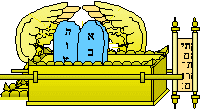
The Ten Commandments were kept in the Ark of the Covenant.
While the other laws were placed beside the ark. (Deuteronomy 31: 26).
Then he took the testimony and put it into the ark ... and put the mercy seat on top of the ark.
(Exodus 40: 20).
... the ark of the covenant covered on all sides with gold in which was a golden jar holding the manna, and Aaron's rod which budded, and the tables of the covenant.
(Hebrews 9: 4).
Take this book of the law and place it beside the ark of the covenant of the Lord your God,
...
(Deuteronomy 31: 26).
- Covenants and Promises. There are other agreements that are based on the laws and promises of God that He makes with His creation.
A covenant has the characteristics of a law because they are permanent as long as both sides keep their agreements.
But covenants are different because they are agreements made between two parties and legally expire at death.
Laws never expire. The laws of Moses are covenants based on keeping the Ten Commandments.
- Environmental Covenants. These were meant to establish the mutual duties of all parts of creation to the welfare of each other.
- Earth. God made a covenant with the land to give it rest. (Leviticus 26: 34).
He also promised a stable agricultural cycle. (Genesis 8: 22). The land also gives up the dead when it is punished for being defiled. (Leviticus 18: 25)
- Sun, Moon, Stars. They would be used for signs and to designate time. (Genesis 1: 14). He promised seasons (Genesis 8: 22).
He promised a fixed order of day and night. (Jeremiah 33: 20; 31: 35-37)
- Spiritual Laws. These are laws that apply to humans.
- Dominion. Humans rule the earth and take care of it. (Genesis 1: 26, 28)
- Law of Sin and Death. The wages of sin is death. (Genesis 2: 16-17)
- The Curses. The law defines the other punishments for those who have been separated from God (Deuteronomy 28: 15-68, Leviticus 26: 14-46).
- Inherited Guilt.
A later generation can suffer the punishment for their ancestors if they commit the same sins and refuse to learn from the past mistakes.
In reality they are suffering for their own sins, but the rejection of the added testimony of their ancestors makes their behavior more unforgivable.
As we show in our lesson on the blessings and curses, God gives us five cycles of chances before He unleashes the final punishment on the fifth time.
On this principle, the seven last plagues are poured out on the final generation.
Even the inhabitants of Sodom and Gomorrah will condemn us because of the testimony and the evidence that we ignored. (Matthew 11: 21-24)
So you testify against yourselves, that you are sons of those who murdered the prophets.
Fill up, then, the measure of the guilt of your fathers.
(Matthew 23: 31-32).
- Wills and Testaments (Inherited Property).
These are enforced at death.
For where a covenant is, there must of necessity be the death of the one who made it.
For a covenant is valid only when men are dead, for it is never in force while the one who makes it lives.
(Hebrews 9: 16-17).
Christ was a paradox that demonstrates the power of God.
His death established the terms of the covenant. Yet His resurrection also guarantees that the covenant will be eternal.
This is one technical detail for which we are very grateful.
- Oath or Vow. An oath is not an agreement made between two people. It is an unbreakable promise made by one.
This is why God advises sinners not to make oaths. We do not have the capacity to keep them in all circumstances.
For the law appoints men as high priests who are weak, but the word of the oath, which came after the law, appoints a Son, made perfect forever.
(Hebrews 7: 28).
The unbreakable promise of God gave us Christ.
for they indeed became priests without an oath, but He with an oath through the One who said to Him.
The Lord has sworn and will not change His mind, You are a priest forever.
(Hebrews 7: 21). See Hebrews 5: 6; Psalm 110: 4.
Breaking And Changing And Reinforcing Covenants
Laws can never be broken. Covenants are technically never broken either.
They are changed to guarantee that they can be kept because they are made with better promises and abilities.
The unfaithfulness of one partner, forces the faithful one to find better ways to keep the covenant.
In this way the following statement is always true. God never changes.
For I, the Lord do not change. Therefore, you sons of Jacob are not consumed.
(Malachi 3: 6).
Our unfaithfulness does not cause Him to immediately enforce the punishments of the covenant, because He is more interested in mercy.
Covenants change for several reasons, but the change is usually not what will be done but who does it.
- Death. Remarriage is allowed on this principle. The death of the old earth ends many environmental covenants.
- Unfaithfulness. Divorce is allowed because of this principle.
- Change in Details. This is what we fondly refer to as the technical details.
For when the priesthood is changed, of necessity there takes place a change of law also.
For the one concerning whom these things are spoken belongs to another tribe, from which no one has officiated at the altar.
(Hebrews 7: 12-13).
- Replacement.
The law of Moses only applied to the priesthood of the tribe of Levi.
God had the right to end the covenant because Israel was unfaithful.
This gave Him the right to establish a new covenant. In this case, "new" does not imply different. It implies better.
It has the same goals and methods and satisfies the same laws.
Better Promises.
But He has obtained a more excellent ministry, by as much as He is also the mediator of a better covenant, which has been enacted on better promises.
For if the first covenant had been faultless, there would have been no occasion sought for a second.
(Hebrews 8: 6-7).
Better Covenant.
For this is the covenant that I will make with the house of Israel after those days says the Lord; "I will put my laws into their minds and write it on the hearts. And I will be their God and they shall be My people.
(Hebrews 8: 10).
These are the better promises of the New Covenant.
- Children. We will be fruitful and our children will survive.
- Land. We will inherit the entire earth, and the Land of Israel will be the new throne of God.
- Name. They will see His face and His name will be on their foreheads. (Revelation 22: 4)
- Law. The law will be in our hearts (Hebrews 8: 10).
- Mediator. Our mediator will not be our accuser. He will be our husband.
- Circumcision. He will put enmity between us and Satan, but bring us closer to God. He is our husband.
- Sacrifice. The sacrifice will be made once for all time.
- Death. There will be no more death.
- Curse. There will no longer be any curse. (Revelation 22: 3)
The covenant is renewed when there is a major change, death, change of name or major fulfillment of an agreement.
| The Renewal of the Covenant |
|---|
| Covenant | Blessings (Promises) | Curse |
| Child | Land | Name | Law | Mediator | Circumcision | Power | Sacrifice | Curse |
| Adam | Genesis 1-2, Hosea 6: 6-7 |  | Earth
| Same Name
 | Word of Mouth
| Promised Son
| Promised Enmity Between the Woman's Seed and the Serpent's Seed | | Clean Animal
| |
|---|
| Noah | Genesis 6: 9-10 | | |
|---|
| Abram | Genesis 12-17; 13: 14-17; 15: 4-5 | | Land of Canaan
| Life in the Dead Womb
| |
|---|
| Abram | Genesis 17: 1-21 | | Abraham | | |
|---|
| Isaac | Genesis 26: 3-4 | | | | Life From Death
| |
|---|
| Jacob | Genesis 28-31; Genesis 35: 10-12 | | Israel
| | |
|---|
| Israel (12 Tribes) | Leviticus 26-27 Exodus 6: 6-8 | | Israel | Written On Stone | Moses (Levites)
| |
Mighty Hand
| Clean Animal
•
Grain
•
Drink
| |
|---|
| First Generation | Before Exodus |
|---|
| Exodus 34: 10 | | | New Miracle
| |
|---|
| Deuteronomy | | | |
|---|
| Second Generation | After Exodus |
|---|
| Jesus | 1 Cor 11: 24-26
Jer 31:31-33 | | Earth | Israel
New Adam | Written On the Heart | Jesus
Melchizedek | Heart
| Blood of Jesus
| Death of Jesus
|
|---|
| John 14 | | Dwelling Places | Holy Spirit | Peace | Holy Spirit |
|---|
| Revelation 22 | | Marriage | Husband | Joined | |
|---|
| Holy Spirit | Adopt | Lives in us | Writer | Helper | Hearts | Curse Removed |
|---|
| Satan | Ezekiel 28: 11-19 | Slavery | Erased | Sin | Accuser | Separation | Defeat | Death |
|---|
Criminal And Civil Justice Laws
| The Deliberate Sin |
|---|
The six cities of refuge were an elaborate system that was set up to absolve a person of unintentional sin.
This is symbolically equivalent to the sin offerings that were used for unintentional sin.
But how is intentional sin forgiven?
In the old system, intentional murder was not forgiven. The congregation condemned them to death.
In the sacrificial system, Christ became the goat or the sin offering and died in the place of the sinner.
This is where the seventh city of refuge comes in.
The New Jerusalem is the place that accepts all sinners and gives all sinners rest from the blood avenger.
Christ reconciles and forgives and dies for us, because the death penalty must be applied for intentional sin.
|
|
When Jesus advocated forgiveness above the "eye for an eye, tooth for a tooth" law He was in effect saying that
you can base your criminal justice system on compassion and forgiveness.
We can follow the perfect way.
Two Witnesses
Also, no one could be condemned on the testimony of one witness. At least two witnesses were needed to testify to the truth.
In Revelation, God also has two witnesses that testified of Him.
They could either be the Law and the Prophets (represented by both Moses and Elijah) on the Mount of Transfiguration.
Or, they could be the Old and New Testament. But since the New Testament was not written or assembled into a book at the time the
prophecies of Revelation were given, the two witnesses might be the Law and the Prophets - both are a light that show the Word of God.
Cities Of Refuge
God set up several cities of refuge for everyone, so that He can show mercy.
Refuge.
The cities which you shall give to the Levites shall be the six cities of refuge, which you shall give for the
man slayer to flee to, and in addition to them you shall give forty two cities.
For Everyone.
These six cities shall be for refuge for the sons of Israel, and for the alien, and for the sojourner among them,
that anyone who kills a person unintentionally may flee there.
(Numbers 35: 6, 15).
The Blood Avenger.
The blood avenger himself shall put the murderer to death; he shall put him to death when he meets him.
(Numbers 35: 19).
The person who commits murder can be killed by an avenger. This is a relative of the person killed.
But the killer can flee to a city of refuge and escape the judgement of the blood avenger.
Here he waits safely for trial or the death of the High Priest.
After the death of the high priest he can go back to his former life.
Trial.
The cities shall be for you as a refuge from the avenger, so that the manslayer will not die
until he stands before the congregation for trial.
Then the congregation shall judge between the slayer and the blood avenger according to these ordinances.
The congregation shall deliver the manslayer from the hand of the blood avenger, and the congregation shall restore him to his city of refuge
to which he fled; and he shall live in it until the death of the high priest who was anointed with the holy oil.
(Numbers 35: 12, 24,25).
Death of the High Priest.
... But after the death of the high priest the manslayer shall return to the land of his possession.
(Numbers 35: 28).
Under the new covenant the sinner will also stand before the congregation for trial at the end of time, after the millennium. The law has not changed.
Under the new covenant the High Priest is Christ and the city of Refuge is the New Jerusalem. (Isaiah 4: 5-6; Psalm 27: 4-5) This law has not changed.
Since our High Priest will never die, this means that we must live in the city of the New Jerusalem or the house of God forever.
This is what happens! Imagine, a law that is meant to show mercy to a sinner, also becomes a wonderful reward.
God is our refuge and strength, a very present help in trouble.
(Psalm 46: 1).
Under the new covenant and the old, God is the avenger. The law has not changed.
Christ is the blood avenger who does not want to take revenge, yet. He wants to forgive.
... Vengeance is Mine, I will repay.
(Hebrews 10: 30; Deuteronomy 32: 35)
Public Health Laws
Public health and sanitation laws are needed to avoid disease.
At the time this law was given, they were a nomadic people, wandering in the desert for forty years.
This law would still apply to any such group of people.
These are basically not moral laws, but wisdom dictates that as long as we follow the
scientific principles we can adapt the laws to our technology.
These ancient laws are very inadequate for the modern size of cities.
So we now have sewer systems, so we no longer need to dig pits certain distances away for our homes.
We just need to make sure that they do not enter our water and food supplies.
The ancient people did not have the technology and resources to build an infrastructure that would take care of their sanitation needs.
Dietary Laws: Clean And Unclean
The original diet was fruits, grains and vegetables for all creation. After the flood, there was no food supply
so God instituted the dietary guidelines and animal flesh was allowed to be consumed under these guidelines.
After this period we notice that man's life span dropped dramatically, from an average of 400 years to 70 years.
The ideal therefore is the original Eden diet.
After Creation
There was a vegetarian diet for all creatures.
Then God said, "Look, I have given you every plant yielding seed that is on the surface of the earth, and
every tree which has fruit yielding seed; it shall be food for you.
And to every beast of the earth and every bird of the sky and to everything that moves on the earth which has life
I have given every green plant for food"; and it was so.
(Genesis 1: 29, 30 ).
| Clean | Unclean |
 |
 |
| Vegetarian | Scavengers |
| Used for sacrifice | Abomination |
|
After The Flood
The rules changed after the flood because the earth was devastated, but this was not the ideal. But at that time everyone knew the concept
of clean and unclean animals.
Clean Animals.
You shall take with you every clean animal by sevens, a male and his female; and of the animals that are not clean two, a male and his female.
(Genesis 7: 2).
Dietary Law.
Every moving thing that is alive shall be food for you; I give all to you as I gave the green plant.
Only you shall not eat flesh with its life, that is its blood.
(Genesis 9: 3-4).
After The Exodus
On Mount Sinai, God gave a more detailed law in Leviticus 11.
He defined the physical difference between clean and unclean animals.
Bending The Laws
With our scientific knowledge, the question usually arises, can we determine what God was trying to protect us from
and use science to make unclean foods clean?
We used that argument for the sanitation laws, why not for the dietary laws?
Could we use the same arguments for having our own modern sanitation systems
in exchange for the old laws to determine how "unclean" foods can be made fit for human use?
We could, but there are at least two problems, first is that we know what God intended and secondly, the remedies that
we use such as heating these foods to a higher temperature were clearly available as an option to the ancients
so why didn't God just tell them to eat these foods only if you cooked them at a higher temperature?
The answer is that modern technology cannot maintain the spiritual truths that are also a part of these prohibitions.
In another lesson we show how the clean animals of the dietary laws represent Christ and why only some of these are used as a sacrifice.
What Was Abolished?
There are some common arguments used to prove that all laws have been repealed.
We intend to show that none of these laws were repealed.
What did occur is that when Christ was inaugurated first as the High Priest, then the King and then the Judge,
He proceeded to appoint judges and to set the times to administer justice.
The message of the Gospel is that as the newly appointed King, He has chosen to make peace with His enemies so that the world is now one family.
The message of the Gospel is also that we have not been appointed as judges and God has set a time for judgment in the future where He presides as the Judge.
The Vision Of Peter (The Gentiles Are Clean)
In fact it was the dietary law, quoted in the vision of Peter that is used as one argument that Jesus did away with all Jewish Laws.
But according to the story these are the facts:
"Get up Peter, kill and eat". (Acts 10: 13)
Peter was hungry when he had a vision. In the vision, Peter saw a great sheet, full of all types of animals - clean and unclean.
Then he heard the invitation to kill and eat. Later the voice said that what God has cleansed is not unholy. According to verse 17, although the vision was
repeated three times he still did not understand what it meant.
- Peter was puzzled as to what the vision meant. Clearly, he still thought that it was not related to a change of the laws
- In the end Peter determined that he should not classify people as clean or unclean anymore.
God has provided cleansing for all people.
Peter's Interpretation.
However, Peter apparently did not think so.
Peter "was perplexed about what the vision meant" (verse 17).
He apparently did not think that God had cleansed the animals.
Then Peter met the gentile Cornelius and a group of foreign believers.
He tells them in Acts 10: 28. "... God has shown me not to call any man common or unclean".
God had cleansed the Gentiles, not the pig.
The Jews could associate with the Gentiles.
The story of the vision of Peter has been used to prove that the law has been done away with and that this was one of the laws "nailed to the cross"
at the death of Jesus.
Eating The Unclean And Clean
Some say that Moses gave permission to eat unclean meat. Moses did not do this.
People Eating at the Temple.
Be careful that you do not offer your burnt offering in every place you see,
but in the place which the Lord chooses in one of your tribes, there you shall offer your burnt offering, and there you shall do all that I command you.
People Eating at Home. However, you may slaughter and eat meat in any of your gates, whatever you desire, according to the blessing of the Lord your God which He has given you; the unclean and the clean may eat it, as of the gazelle and the deer.
Just as a gazelle or deer is eaten, so you will eat it, the unclean and the clean alike may eat it.
(Deuteronomy 12: 13-15, 22)
The text said, "the clean and unclean may eat", not "the clean and the unclean may be eaten".
It is the status of the eater that is addressed, not the food.
This chapter addresses eating things dedicated to God and eating ordinary feasts outside the temple.
The temple offerings must be eaten at the temple, and only the clean are allowed enter the camp ( Numbers 5: 2) Leviticus 21: 17-20).
However, outside the temple, both the clean and unclean people can eat any clean meat such as a deer and gazelle.
The Law Has Not Changed
His arrival did not change the definition of sin, He only brought a cure.
The Bible cannot contradict itself. Jesus did not come to abolish the law, instead He did the following.
- The Law Has Been Magnified. Jesus said He came to make the law great and glorious or magnify the law (Isaiah 42: 21 KJV),
- The Law Remains Until All is Fulfilled. Jesus said He did not come to abolish the law or the prophets and that not the smallest letter or stroke shall be removed from the law until all is accomplished (Matthew 5: 17-18).
Everything has not been fulfilled. So nothing has been removed from the law.
- The Law Remains Until Heaven and Earth Pass Away. He also said it is easier for heaven and earth to pass away than for one stroke of a letter of the law to fail (Luke 16: 17).
Heaven and earth have not passed away. Therefore all laws are in effect. So no laws have been changed.
These last two points seem to make Jesus a liar because He appeared to change several laws such as, "an eye for an eye", "love your enemy", "do not judge" and "do not take revenge".
We discuss this apparent contradiction below and not only prove that He did not change these laws, but show that He executes all these laws in the future.
Which laws were magnified, which were nailed to the cross?
He magnified the Ten Commandments, making motives and thoughts just as offensive as deeds.
While they do not have the third party effects that the actual deed does, they possibly bear the same guilt as the one who initiated the thought or the action.
The Unclean
I know and am convinced in the Lord that nothing is unclean in itself; but to him who thinks to be unclean, to him it is unclean.
(Romans 14: 14).
For everything created by God is good, and nothing is to be rejected if it is received with gratitude.
For it is sanctified by means of the word of God and prayer.
(1 Timothy 4: 4-5).
From the New Testament we now learn that nothing was created that was basically unclean.
And that what was once unclean can become clean.
So let us look at these things and expand our understanding of the concept of unclean.
Things are defined as unclean because they represent realities that will not exist in Heaven. And they do not represent Christ.
- Gentiles.
A Gentile is unclean because in Heaven all people will know and obey the true God of Israel.
- Animals. Unclean animals are not vegetarian.
An animal is unclean because in heaven they will be vegetarian and mild. They will not kill each other for food.
- Dead Bodies. The dead are unclean because death will not exist in heaven.
- Unclean Spirits. The demons of Revelation 16 are unclean because they are in a place where do not belong, behaving in a manner for which they were not created.
Angels are messengers of God who do the will of God, they are not supposed to be leading a rebellion against God.
And angels who did not keep their own domain, but abandoned their proper abode, He has kept in eternal bonds under darkness for the judgment of the great day.
(Jude 1: 6).
The fact that God allowed clean flesh to be eaten after the flood, shows that the
concerns about food are not in the same realm as idolatry.
Idolatry always leads to death.
Food leads to life, even if some foods eventually shorten the life span.
So, in the defense of life and in an emergency certain behaviors are allowed.
Taking a life for self defense is allowed, but not murder.
Eating any available flesh is preferable to starvation.
But the ideal that exists in heaven will not include these. So there is nothing wrong in striving for the ideal.
So the principle is not an inherent defect or unclean state of the object that is avoided.
The highest principle is preserving life.
Nailed To The Cross
The second argument says that Jesus took certain laws and "nailed them to the cross". This passage is also given as proof that the laws were abolished along with the Holy Sabbath day.
Having canceled out the certificate of debt consisting of decrees against us, which were hostile to us; and he has taken it out of the way, having nailed it to the cross.
Therefore no one is to act as your judge in regard to food or drink or in respect to a festival or a new moon or a Sabbath day
things which were a mere shadow of what is to come; but the substance belongs to Christ.
(Colossians 2: 14, 16 - 17)
Do Not Judge.
Food or drink, festivals, new moon and Sabbaths.
All these things were part of the ceremonial laws.
The laws that required all the killing of animals was "contrary to them".
These were taken away and nailed to the cross.
The curses were also hostile to them and Christ suffered those on the cross. These were nailed to the cross, or accomplished by Christ.
Let us compare the laws.
- The Laws In Handwriting. The commandments were written on stone by the finger of God.
Moses wrote everything else and the "ceremonial laws" and the curses with his own hand.
- Ceremonial Laws. What are these laws? The words are not in the Old or New Testament, but people include these.
- Food and drink. Every sacrifice included a food and drink offering.
- Festivals. There were several festivals which pointed to the work of Christ.
- New Moon. This was the first day of the month. It was a special time that required additional ceremonies.
- Offering. An additional offering was also made on the new moon and Sabbath. (Numbers 28: 9,11)
- Trumpet Call. On the new moon and festivals the trumpet was blown (Numbers 10: 10).
- New Moon Sabbath. This festival of the feast of trumpets occurred on a new moon. (Numbers 29: 1)
The new moon ceremonies will survive in heaven. This is probably because we will perpetually assemble before God in humility as on the feast of trumpets.
It shall be from new moon to new moon and from Sabbath to Sabbath all mankind will come to bow down before Me.
(Isaiah 66: 23)
- Sabbaths . There were seven other Sabbaths days associated with the festivals and eight Sabbath years associated with the land every forty nine years.
They were fulfilled in that they were prophecies that were fulfilled by the actions of Christ.
- Passover (Day 2). Christ died as the Passover lamb, one time for all.
- Wave Offering. Christ presented Himself to the Father on the Sunday after He died.
- Pentecost. The Holy Spirit came.
- Feast of Trumpets. God judges us.
- Day of Atonement. God defends and justifies us.
- Feast of Tabernacles (Day 1). The birth of Christ, the Second Coming and the church is in heaven.
- Feast of Tabernacles (Day 8). The circumcision of Christ and the permanent removal of sin when we arrive back on the earth.
The last four Sabbaths might have been fulfilled in heaven by a ceremony with the first fruits.
By 1844, the Day of Atonement and the Feast of Trumpets was fulfilled.
However, since Christ has not returned, the feast of tabernacles may not have been fulfilled in its most complete form because humans have not gone to live with God.
But, if you look at the birth of Christ, one might argue that the feast of tabernacles was fulfilled by His birth and His circumcision, when God came to tabernacle or live with humans.
But we rejected Him and sent Him back. So this feast must be completely fulfilled when we go to live with God.
These feasts seem to be in transition and all can be linked to unfulfilled prophecies and nothing shall be done away with until "heaven an earth pass away".
So while the curses will be totally removed, the feasts may be transformed into something more glorious, based on the same principles.
- The Curses: A Ministry of Death. They list the penalties for breaking the law. Death and curses.
They also give the procedures by which God, through Christ, is reconciling the world to Him by paying those penalties. This is by the suffering and death of God.
First Plan (Old Covenant): Ministry of Death. Above when He said, "sacrifice and offering and burnt offerings and offering for sin you would not, neither have pleasure in them which are offered by law.
Second Plan (New Covenant): Ministry of Life. Then said He, "Lo, I come to do Thy will, O God".
Life Insurance.
He takes away the first, that He may establish the second.
(Hebrews 10: 8-9)
Christ was nailed to the cross. The system of continually sacrificing animals was gone forever.
This was a law that was hostile to Christ and to the animal kingdom.
It was taken away so that a better system could be installed.
The better system removed the curses, stopped the ceremonial laws that required continual killings and sacrifices and cured the sinner of the desire to sin so that they are no longer under condemnation by the Ten Commandments.
» The Ten Commandments: A Ministry of Death and Condemnation?
Paul seems to suggest that the law written on stones has been annulled.
The only law that was written on stones is the Ten Commandments, not the ceremonial laws or curses.
So it is the Ten Commandments that is annulled as the argument states.
We can understand Paul's reasoning if we understand the perspective if the Plan of Salvation.
We are sinners. All the law can do is to define sin for us and remind us that we are condemned to death.
It is useless in fixing the problem of sin.
But the Law has not been repealed. It had been written on something better.
This is the promise of the new covenant.
Old Covenant. Sacrifice and meal offering You have not desired. My ears You have opened. Burnt offering and sin offering You have not required.
Then I said, "Behold I come. In the scroll of the book it is written of me".
New Covenant. I delight to do Your will, O my God. Your law is written in my heart.
(Psalm 40: 6-8)
The new covenant opens our ears and writes the Law on our heart.
- A Ministry That Kills. Paul also calls these laws a ministry of death.
Remember that the details of the ministry of death was written in the ceremonial laws to satisfy the punishments demanded by the curses.
This ministry required sacrifices and blood that was taken and sprinkled before the covenant (the Ten Commandments).
Yet, since it did not perfect the sinner, this ministry of continual death could potentially continue forever.
It Kills. who has made us adequate as servants of a new covenant, not of the letter but of the Spirit. For the letter kills, but the Spirit gives life.
Ministry of Death. But if the ministry of death, in letters engraved on stones, came with glory, so that the sons of Israel could not look intently at the face of Moses because of the glory of his face, fading as it was,
how will the ministry of the Spirit fail to be even more with glory?
Ministry of Condemnation. For if the ministry of condemnation has glory, much more does the ministry of righteousness abound in glory.
(2 Corinthians 3: 6-9)
You can focus on the negative portrayal of the law and forget that Paul also says that this Law is glorious.
However, Paul says that it is not as glorious as the permanent solution.
The external Law on stones can show us what is sin and what makes us fall short of the glory of God. It cannot help us to be faithful to the laws.
A Letter Written on Flesh.
being manifested that you are a letter of Christ, cared for by us, written not with ink but with the Spirit of the living God, not on tablets of stone but on tablets of human hearts.
(2 Corinthians 3: 3)
However, the internal Law written on the fleshy heart by the Holy Spirit is the permanent solution.
But it is the same list of Laws. Written on stones it is useless, but written on the heart it is powerful.
If is remains written only on stone then we are doomed to death, because we will remain sinners.
When we are perfect then there is no need of sacrifices, so this solution ends the ministry of death but it does not end the Law.
- A Ministry That Is Passing Away.
This ministry of condemnation will pass away when it is replaced by the better method of writing it on our hearts.
It is Passing Away. For if that which fades away was with glory, much more that which remains is in glory.
(2 Corinthians 3: 11)
Remember that God said the following about the law. Christ did not come to remove the law.
The Law Had Not Passed Away.
Think not that I am come to destroy the law, or the prophets: I am not come to destroy, but to fulfill. For truly I say to you, Until heaven and earth pass, one jot or one tittle shall in no wise pass from the law, till all be fulfilled.
Whoever therefore shall break one of these least commandments, and shall teach men so, he shall be called the least in the kingdom of heaven: but whoever shall do and teach them, the same shall be called great in the kingdom of heaven. For I say to you, That except your righteousness shall exceed the righteousness of the scribes and Pharisees, you shall in no case enter into the kingdom of heaven.
(Matthew 5: 17-20)
» When Heaven and Earth Pass Away.
So even if it is passing away, it will not pass away until the new heavens and earth are created.
It will pass away after people are judged by the Ten Commandments.
By then nobody will have to teach the law from an external source. Everyone will know what the Law requires.
Taught by the Spirit.
As for you, the anointing which you received from Him abides in you, and you do not need for anyone to teach you; but as His anointing teaches you about all things, and is true and is not a lie, and just as it has taught you, you abide in Him.
(1 John 2: 27)
This is not an undisciplined, haphazard, personal belief based on feelings where everyone does what is right in his own eyes.
Even the Spirit cannot contradict the written word. His anointing must be "true and not a lie". So the Spirit that teaches must also uphold the Ten Commandments because He teaches out out of the Law.
» The Law of Sacrifices.
Yet we can say that even the sacrificial law has not been done away with because our sins are being atoned by the blood of Christ who was sacrificed.
We still use a sacrificial system through a High Priest who is still following all the laws of the Old Testament to remove our sins.
The difference is that we do not need to make another sacrifice because the Lamb of God is still fresh and still bleeding and He promises to perfect us.
- A Dead Law or A Dead Sinner?
Some claim that Paul teaches that the Law is dead.
Death annuls all contracts and responsibilities such as marriage. This is why remarriage is allowed after the death of a spouse and why no legal marriages will exist at the resurrection of the dead.
So if the law is dead then it does not have jurisdiction over us.
Our Contract With The Law.
The law has jurisdiction over a person as long as he lives.
The Dead Sinner.
But now we have been released from the Law, having died to that by which we are bound, so that we serve in the newness of the Spirit and not in oldness of the letter.
(Romans 7: 1,4,6)
Paul makes the logical argument that a contract ends when one of the parties dies.
But in this argument it is not the Law that dies it is the sinner.
However, even if is is the sinner who dies, that still releases us from the contract we have with the Law.
But we must be joined to Christ who can raise us from the dead because He gained the power to raise the dead.
What does this new marriage to Christ do?
It binds us to a contract with Christ. We keep the same set of Laws but it is based on better promises and a better method for keeping it that He inaugurated.
Christ had the same laws of God written in His heart. He came to honor and keep those laws.
The objects in the Ark of the Covenant tell us what Christ will accomplish by the mercy of God.
- Ten Commandments. A promise to keep the Law.
- Aaron's Rod that Budded and Grew Almonds. A promise of resurrection and bearing fruit
- Jar of Manna. A promise to remove the power of the curses.
The Law Does Not Make Us Sin.
What shall we say then? Is the Law sin? May it never be!
The Law Defines Sin.On the contrary, I would not have come to know sin except through the Law; for I would not have known about coveting if the Law had not said, "You shall not covet".
(Romans 7: 7)
Internally, we now naturally know what is sin, not because we do what we feel is right.
We know what is sin because the same set of laws written on stone is the same set of laws written on the heart.
» The Renewing of the Covenant.
If you look at the history of the Covenant in the Old Testament, God always renews the same covenant with each Generation.
It is always the same promises and terms. God never deletes or removes any terms, but He always adds something new or better to strengthen the covenant.
This is what happened with Christ. It is the same covenant, same laws and same rules, but with better provisions.
A permanent and better High Priest and sacrifice and a better way of keeping the Law.
God basically says, if they will not read it and learn it and obey it, then why not write it in their minds in the place where they love?
- The Hostile Laws. The covenant curses are the hostile laws that were against them. Christ suffered these curses for the righteous on the cross. He took it away.
• The Curses.
Take this book of the law and place it beside the ark of the covenant of the Lord your God,
that it may remain there as a witness against you.
(Deuteronomy 31: 26).
I call heaven and earth to witness against you today;
that I have set before you life and death, the blessings and the curse.
So choose life that you may live, you and your descendants.
(Deuteronomy 30: 19).
Christ redeemed us from the curse of the law, having become a curse for us ....
(Galatians 3: 13).
• The Law of Commandments Contained in Ordinances.
Certain "ceremonial laws" were also called divisive.
These were changes to the laws that united us, like the priesthood of men where all can enter the sanctuary.
But now in Christ Jesus you who formerly were far off have been brought near by the blood of Christ.
For He Himself is our peace, who made both groups into one and broke down the barrier of the dividing wall,
by abolishing in His flesh the enmity, which is the Law of commandments contained in ordinances, so that in Himself He might make the two into one new man, so establishing peace.
(Ephesians 2: 13-15).
» The Divisions.
Christ made peace with various groups by His death. It was symbolized by the veil at the Most Holy Place which was torn in two (Matthew 27: 51).
- Enmity. The Levitical priest laws that kept even the Jews out of the sanctuary. The Levitical priesthood ended, Melchizadek priesthood begins. Here all men are priests.
- Jews and Gentiles. There is peace between all people, because we are all children of Israel in Christ.
- Priests and Common People. The common people can now enter the Holy Place of the sanctuary, because they are now priests of God and only priests can enter the sanctuary.
- Heaven and Earth. There is peace between heaven and earth. The people of earth can enter heaven because the High Priest has removed the dividing wall at the Most Holy Place and He has invited all the priests to come in.
Changing The Feasts And Sabbaths After The Crucifixion.
One person regards one day above another, another regards every day alike.
Each person must be fully convinced in his own mind.
He who observes the day, observes it for the Lord.
And he who eats does so for the Lord, for he gives thanks to God;
And he who eats not, for the Lord he does not eat, and gives thanks to God.
(Romans 14: 5-6)
The argument here is not about the weekly Sabbath.
It was about keeping the ceremonial Sabbaths and the meals associated with them.
But Paul concludes that those who keep them are still remembering the Lord.
And those who do not remember the Lord on that day through that meal can still gives thanks to God for Christ without an accompanying feast.
All the confusion can be resolved if you understand the decisions they faced.
The issues after the crucifixion were how to change the feasts to reflect the sacrifice of the perfect lamb.
Let us look at the problems involving the Passover meal (seder).
- Meat. The seder plate has two servings of meat.
- Vegetables. There were three servings of vegetables and herbs and one dish of nuts and spices.
- Drink. The seder includes four glasses of wine and unleavened bread.
Food.
One person has faith that he may eat all things, but he who is weak eats vegetables only.
(Romans 14: 2)
So after the crucifixion the issue was, "do we eat the vegetables only?" And if we eat a Passover lamb are we denying the perfect sacrifice of Christ by essentially condoning animal sacrifice?
Paul's answer really reflects the fact that it depends on if we fully understand the meaning of the symbols.
We can celebrate these feasts as often as possible as long as we acknowledge the correct and complete actions of Christ.
We will not be returning to bondage if we diminish the importance of the non-Sabbath portions of the feasts by explaining their fulfillment.
If you compare our Easter traditions to the Passover Seder it is clear that we did not understand the power of Passover and we would have been better off if we had kept Passover instead.
Bondage and Freedom.
Let us look at the changes to the feast days before we understand Paul's reasoning in Galatians 4.
| Bondage Years |  | Sabbath Rest Fulfillment (After Crucifixion) |
| Work Days | Feast Sabbaths |
| No Rest | Spiritual and Mental Rest | Christ
Comes | Physical Rest |
| Law on Stone |
 |
Pentecost |
|
Latter Rain | Fruit Harvest (Law in the Heart) |
| Sin | Israel | Christ |
 |
Day of Atonement (Now) |
|
New Body | Millennium |  |
New Earth |
| Child Heirs | Redeemer |  Passover Passover |
Wavesheaf |  | Tabernacles |
| Slaves and Managers |
Land Sabbath |
Jubilee Evening |
 |
Night | |
Jubilee Morning |
| Darkness |
 |
Dawn |
 |
Full Moon Light |
 |
Light |
| Sons of the Flesh | Sons of the Promise (Adoption) |
Technically, the feasts laws have not been abolished. We are simply living during the sabbaths of those feasts in the years after Christ.
It is a time of rest and freedom when we are being represented by the High Priest on the Day of Atonement.
So, like the food, the issue is how do we celebrate those sabbaths and the period leading up to the Sabbath.
Those days represent the time of bondage before Christ died. The Sabbath represents the rest we have after Christ came.
» Sabbaths Abolished?
Howbeit then, when ye knew not God, ye did service unto them which by nature are no gods.
But now that you have come to know God, or rather to be known by God, how is it that you turn back again to the weak and worthless elemental things, to which you desire to be enslaved all over again?
You observe days and months and seasons and years.
(Galatians 4: 8-10)
So when Paul laments the times we celebrate, he condemns the times that are symbolic of our slavery.
- Those Who Have Come To Know God. To whom was Paul talking? He must have been talking to the Gentiles who "knew not God" but "did serve those who are not God by nature".
Then all the men which knew that their wives had burned incense unto other gods, and all the women that stood by, a great multitude, even all the people that dwelt in the land of Egypt, in Pathros, answered Jeremiah, saying,
As for the word that thou hast spoken unto us in the name of the Lord, we will not hearken unto thee.
But we will certainly do whatsoever thing goeth forth out of our own mouth, to burn incense unto the queen of heaven, and to pour out drink offerings unto her, as we have done, we, and our fathers, our kings, and our princes, in the cities of Judah, and in the streets of Jerusalem: for then had we plenty of victuals, and were well, and saw no evil.
(Jeremiah 44: 15-17)
Therefore, his reference to observation of "days and months and seasons and years" may be referring to Pagan religious worship, not Jewish worship time which were not worthless.
Since the ancient Hebrews practiced heathen customs, even the Jews could have restarted ancient customs in their new found freedom.
These festivals existed thousands of years from the time of Nimrod to Egypt, Rome and Greece and spread through Europe.
The festival of Ides came all the way back to the days of the Indo-Europeans.
The Etruscans introduced Saturnalia to the Italian peninsula and to the Romans and the Greeks.
- Pagan Days Observed.
There was a counterfeit worship times throughout the year which preceded Christ among the Hebrews and the Gentiles. There was tree worship, seasonal worship and days.
- Years (March Ides). This was originally the New Year's Day, festival to Anna Perenna, the goddess of the year, and was a general holiday.
- Months. March was originally the beginning of the year and many days were dedicated to a Roman god in every month.
- Seasons (Winter). December 25 was the concluding day of the pagan winter festival called the "Saturnalia" by the Romans.
- Brumalia (November 24 - December 17). Winter solstice festival honouring Saturn/Cronus and Ceres/Demeter, and Bacchus in some cases.
- Consualia (Halcyon Days December 15-28). There were many festivals, celebrations, sacrifices and games.
But seven days before and after the solstice were dedicated to Consus - the god of time.
- Saturnalia (December 17-21). The Roman festival of light dedicated to Saturn for the mid-winter celebration of the solstice.
It was a one day affair until the emperor Aurelian.
The days began to lengthen after the solstice.
- Sigillaria (December 22). The Feast of Dolls, when a fair was held, and dolls and other toys, mostly of earthenware, were given to children.
- Days (Ides). Hundreds of years before Christ, festivals to Jupiter occurred on the 13th day of each month.
- Festival Of The New Sun (December 25) . Observed by Mithraism as the "Dies Natalis Invicti Solis", the Birthday of the Unconquered Sun.
It was the "birth day" of the sun-god, "Sol Invictus" or "Mithras" which was celebrated for thousands of years in Egypt and Babylon before the birth of Christ.
Emperor Aurelian erected a temple to Sol Invictus in AD 274. He was devoted to a single sun god and during his reign it became a public festival and chariot racing in the Circus.
- Roman Games - Ludi Romani (September 4-19).
They began around 366 BC in honor of Jupiter, games as a vow from the commander for victory in battle.
They were originally celebrated at the triumph of the general. Annual celebrations began later, lasting from September 5-19., then from September 4 to October 26 (Ludi Victoriae Sullanae).
» Years (Olympic Games). Held every 4 years, these athletic competitions began in Greece in 776 BC and continued after the Roman conquest until the emperor Theodosius I suppressed them in 394 AD as a strategy to impose Christianity.
The first modern Olympic Games in Athens (1859).
The original Olympics also featured religious celebrations and artistic competitions.
By the time persecution ended and the church was in the ascendancy pagan feasts became Christian festivals with a change of name and worship.
- Jewish Days Observed.
- Days.
The seven ceremonial Sabbaths represent our rest from various consequences of sin.
However, except tabernacles, the days before the sabbaths represents slavery and death. Nisan 14 was the condemnation and death of Christ. Nisan 15 was the sabbath.
- Months. The entire months of Tishri and Nisan are filled with feast days. The weeks leading up to Pentecost represent the times without the Messiah when we are waiting for the promise of the Holy Spirit.
» Weeks. From Nisan to Sivan the feast of weeks is celebrated.
- Seasons. The spring and fall seasons are the time of feasts of Nisan and Tishri.
- Years. The Sabbath years and the Jubilee. The six years before the sabbath and the 49 years before the jubilee represent the times of slavery and debt.
» End of Slavery.
After the crucifixion, the system of debt bondage was abolished. It had served its purpose like animal sacrifices.
That system taught them what God would do for them and the terms of the slavery into which Adam and Eve had sold us.
God does not condone slavery anymore than He condones animal sacrifices. But slavery was where He found us and from which He had to redeem us.
So the terms of slavery were regulated until we had freedom in Christ.
It is now clear why Jesus said that the laws are not abolished until all is fulfilled. They still exist. We are merely living in the Sabbath days of the feasts.
So we have another controversy. How do we regard the normal calendar in this period of perpetual Sabbath?
» Are All Days Equal?
One person regards one day above another, another regards every day alike. Each person must be fully convinced in his own mind.
(Romans 14: 5)
He who observes the day, observes it for the Lord, and he who eats does so for the Lord, for he gives thanks to God; and he who eats not, for the Lord he does not eat, and gives thanks to God.
(Romans 14: 6)
Finally, we can understand Paul's attitude.
When we observe the feast days correctly, we are acknowledging what Christ accomplished.
When we eat the meat in the Passover, we are remembering how they gnashed their teeth at Him, spit on Him and tore Him apart.
This is really no different than eating the broken bread, except that now an unnecessary death occurs to preserve the symbol when we eat the meat.
This is why some might eat the vegetables and the bread only.
However, both groups give thanks to God if they acknowledge both the bondage that God suffered as well as the freedom He provided.
When Christ asks us to eat the bread and wine to remember His death, He was telling us to remember the bondage from which He saved us.
All the feast Sabbaths point to rest from some aspect of the consequences of sin.
- Weekly Sabbath (Rest From Hard Labor, Creation and Recreation). This Sabbath provides one other purpose. It celebrates the power of God and the completed work. We do not rest from this task of praising God.
We rest from all other works so that we can praise and honor Him together as one grateful creation.
- Passover (Rest From the Penalty of Sin and the Curse). This is the one feast that we can agree seems to be fulfilled, yet Jesus asked the disciples to still do this to remember Him. Why?
The feasts still prove to the future generations that Jesus was the Messiah 2000 years after the event and they prove that God can predict the future in great detail.
Furthermore, Jesus seems to suggest that it is only partially fulfilled. He has not drunk the fourth cup.
And when he had given thanks, he brake it, and said, Take, eat: this is my body, which is broken for you: this do in remembrance of me.
After the same manner also he took the cup, when he had supped, saying, this cup is the new testament in my blood: this you should do, as often as you drink it, in remembrance of me.
For as often as you eat this bread, and drink this cup, you do show the Lord's death till He comes.
(1 Corinthians 11: 24-26)
The broken bread and the first three cups point to His death. The fourth cup points to His return.
 The global Passover is not complete until He drinks the fourth cup.
» The Barley Harvest Wavesheaf (Rest From Death). This was fulfilled at the resurrection and it may not be fulfilled again until the final fruit harvest which ends in the general resurrection of all the righteous.
The global wavesheaf is not complete until the first resurrection at the Second Coming.
» Land Sabbath (Year 7 and 49).
The result of the crucifixion represents the spiritual rest coming to the earth during the land Sabbaths. But the Jubilee represents the coming of the Holy Spirit in year 50.
- Pentecost (Rest From the Desire to Sin). This feast was fulfilled when the Holy Spirit came to write the law into our hearts. However, since Joel predicts that the Holy Spirit will be poured out again there may be another outpouring of the Holy Spirit during this feast for the last generation.
The global Pentecost is not complete until the second outpouring of the Holy Spirit and the people obtain perfection when the law is written on our hearts.
» The Wheat Harvest Wavesheaf. This was fulfilled at Pentecost. However in the future, we expect a great harvest of Jews as a part of the fruit harvest.
- Rosh Hashannah (Rest From Darkness). This feast is being fulfilled. We cannot separate the issues of Rosh Hashannah from Yom Kippur.
The global feast of trumpets or call to judgment is not complete until the judgment before the throne of God ends.
» New Moon. Rosh Hashannah is the most important of the new moon ceremonies. These represent the beginning of a new phase of the church. Only six new moons have been fulfilled. See the prophecy of the seven churches.
The purpose for keeping them now would be to remind ourselves of the link between the first and last church.
- Yom Kippur (Rest From Accusation and Condemnation). This feast has not been fulfilled. Only the Lord's Goat has been killed. But we are living during the period of Yom Kippur so it would be wise to learn this feast so we can be filled with the sense of awe about how important the issues are.
The global Yom Kippur is not complete until the scapegoat is banished at the Second Coming and killed at the Third Coming.
- Tabernacles (Rest From Imprisonment and Separation). This feast has not been fulfilled. In fact, they contain instructions for the last generation.
There were two Sabbaths at the beginning and the end. Both represent leaving the old earth and returning to the new earth so that we can rest in a place of perfection.
The two sabbaths of the global tabernacles have only begun in faith as the Holy Spirit lives with us. Pentecost is the promise of that new life, that is counted like the jubilee. It is day fifty after counting seven weeks like the jubilee is year fifty after counting seven weeks of years.
The first jubilee Sabbath begins at the Second Coming when we live in temporary shelters with God in heaven.
It is only during the second sabbath of tabernacles at the third coming that we will live in permanent homes with God after He creates the new heavens and earth.
So the issue is how do we regard the ceremonial Sabbaths if the weekly Sabbath celebrates the rest that they prophesied about?
If you celebrate the weekly Sabbath and highlight these freedoms then I can also conclude with Paul that you can decide about keeping the ceremonial Sabbaths annually because you are already keeping them weekly.
So we conclude with the writer of Hebrews that there remains a rest for the people of God and He would not have given another day (Hebrews 4: 8-11).
The weekly Sabbath, created before sin, is the only Sabbath that celebrates all these periods of rest.
We get to celebrate the rest provided by all the feast sabbaths as often as possible every Sabbath.
So Jesus rested on the weekly Sabbath at His death because the two Sabbaths had merged. This might establish a pattern that every time one of these global Sabbaths are fulfilled, it will be fulfilled on a high Sabbath.
So the weekly Sabbath will take the place of all the feast Sabbaths.
Passover was celebrated once a year, but Jesus indicated that we can do it "as often as possible".
So that like the Passover, we can remember Jesus as often as possible when we remember the feast sabbaths every weekly Sabbath.
Freedom.
Does this knowledge means that we are free to ignore the appointed days.
Probably not, since they are still being fulfilled.
The writer of Psalms concluded that even though animal sacrifices did not remove sin, Israel had to obey this law until the Messiah came 1000 years later, becaue His instructions were in these laws and ceremonies.
All Feasts Fulfilled.
| Feasts | Days of Bondage | Sabbath Rest |
| Before Christ | Spiritual Rest | Physical Rest |
| 1 | Passover | Nisan 14 | Wrath and death | Nisan 15 | No condemnation | Reconciliation |
| 2 | Unleavened Bread | Nisan 14-21 | Sin, guilt and shame | Nisan 21 | No sin |
| Wavesheaf | - | Death | Nisan 16 | No death |
| 3 | Pentecost | Nisan-Sivan | 49 days of mourning and waiting | Sivan 5 | Jubilee.
Power over sin | Perfection |
| 4 | Rosh Hashannah | Tishri 1-10 | Ten days of judgment | Tishri 1 | Sin stopped | Judgment |
| 5 | Yom Kippur | Tishri 10 | Year of judgment | Tishri 10 | No condemnation | 1844 - Start of Plagues |
| 6 | Land Sabbath | » | Year 1-6 | 6 years of slavery | Year 7 | Freedom | Millennium |
| 7 | Jubilee | » | Year 1-49 | 49 years of slavery, homelessness and economic bondage | Year 50 | Property restored | Third Coming
New heaven and earth |
| 8 | Tabernacles | Tishri 15-21 | Living in temporary shelters | Tishri 15 | Rescued | Millennium |
| - | Fruit Harvest | Tishri | Righteous character | Resurrection |
| 9 | Tishri 22 | New beginning | Tishri 22 | Permanent home | Third Coming |
Remember that there is a spiritual and physical fulfillment of the feasts.
As we have just demonstrated, the death of Jesus Christ ushered in the spiritual fulfillment of all these feasts and their Sabbaths.
However, at the Second Coming, the physical fulfillment of the autumn feasts will occur.
Slavery.
Slavery is not a wonderful idea that simply needs regulation or benevolent owners.
Regulations on slavery are addressed by the Bible because slavery was the conditions under which God found us after sin began.
When Adam and Eve sinned they sold themselves and their children into slavery to a kidnapper and tyrant who held us for ransom.
While we waited for God to pay the ransom, we were held in bondage to sin.
Amazingly, after the ransom was paid and while God is leading us out on an exodus we want to stay in bondage and return to slavery!
So, technically the laws on slavery still exist. But after the crucifixion we were free men waiting for an inheritance and waiting to return home.
But it is not freedom from the law, it is strength to keep the law.
Our inheritance is a pure heart and eternal life.
So, if the laws on slavery still exist, can Christians own slaves?
No! We cannot. The laws on slavery have two conditions that prevent us from owning slaves.
- Forced Slavery. There is a death penalty for kidnapping and forced slavery (Exodus 21: 16).
- Voluntary Slavery. We are not allowed to enslave our brother. Christ reconciled the world into one group and everyone is our brother to whom we have a duty to rescue from slavery, even if poverty forces them to sell themselves to a stranger.
An Eye For An Eye.
If a man injures his neighbor, just as he has done, so it shall be done to him.
Fracture for fracture, eye for eye, tooth for tooth, just as he has injured a man, so it shall be inflicted on him.
(Leviticus 24: 19-20)
eye for eye, tooth for tooth, hand for hand, foot for foot, burn for burn, wound for wound, bruise for bruise.
(Exodus 21: 24-25)
Thus, you shall not show pity, life for life, eye for eye, tooth for tooth, hand for hand, foot for foot.
(Deuteronomy 19: 21 )
The Pacifist Directive.
You have heard it was said, "an eye for an eye and a tooth for a tooth". But I say to you, do not resist an evil person;
but whoever slaps you on your right cheek, turn the other to him also.
(Matthew 5: 38-39)
This verse appears to signify a change in the law. Is God a liar when He says that He does not change?
Or has Jesus abolished some laws by His death?
I submit that the law has not been changed, what has changed are the circumstances that affect how this law can be executed.
This was the law under the theocracy. God no longer has a theocracy on earth in which humans are agents of justice. We are under a theocracy but the administers are in heaven.
So the justice under this law will be meted out when He takes revenge from the time of the seven last plagues to hell fire.
He will take revenge at that time. Vengeance is His territory according to Hebrews 10 because the justice of man does not achieve real righteousness.
... Vengeance is Mine, I will repay.
(Hebrews 10: 30; Deuteronomy 32: 35)
... But everyone must be quick to listen, slow to speak and slow to anger.
For the anger of man does not achieve the righteousness of God.
(James 1: 19-20)
Two Eyes for an Eye!
In the final punishment of Babylon we see a more severe form of this law once again.
Pay her back even as she has paid, and give back to her double according to her deeds, in the cup which she has mixed, mix twice as much for her.
To the degree that she has glorified herself and lived sensuously, to the same degree give her torment and mourning ...
(Revelation 18: 6-7)
Many Eyes for an Eye! For the righteous it is even greater! God does not give us what we deserve and He does not simply give us back what we have lost.
Instead, He gives us in such abundance that we cannot comprehend it.
It is written, "Things which the eye has not seen and the ear has not heard, and which has not entered
into the heart of man, all that God has prepared for those who love Him".
(1 Corinthians 2: 9)
Hate Your Enemy.
Another law appears to be changed also.
You have heard that it is said, "Love your neighbour and hate your enemy". But I say to you,
"love your enemies and pray for those who persecute you".
(Matthew 5: 43-44)
Love your Neighbour.
You shall not take vengeance, nor bear any grudge against the sons of your people, but you shall love your neighbour as yourself. I am the Lord.
(Leviticus 19: 18)
Hate your Enemy.
No Ammonite or Moabite shall enter the assembly of the Lord ... because they did not meet you with food and water on the way ...
You shall never seek their peace or their prosperity all their days.
(Deuteronomy 23: 3-6)
The new directive seems to say that your enemy should be treated as your brother.
This is because the Gentiles are now formally included in the plan and the former enemy is now your brother.
But in the judgment, those who are cast out will be treated as enemies under this law.
We are still supposed to hate evil and resist Satan and work to stop his kingdom. Satan is our real enemy.
And I will put enmity between you and the woman, and between your seed and her seed ...
(Genesis 3: 15)
» God Makes Peace.
The law did not change. The status of the people who came under this law changed because Christ made peace with His enemies.
With Christ, the house of God got larger when the definition of neighbor and brother became more inclusive.
But now in Christ Jesus you who formerly were far off have been brought near by the blood of Christ.
For He Himself is our peace, who made both groups into one and broke down the barrier of the dividing wall.
(Ephesians 2: 13-14)
Stoned For Adultery.
This is another story that seems to point to the end of old laws.
They said to Him, "Teacher, this woman has been caught in adultery, in the very act".
Now the law of Moses commanded us to stone such a woman, what then do you say?
...
But when they persisted in asking Him, He straightened up and said to them,
"He who is without sin among you, let him be the first to throw a stone at her".
(John 8: 4,5,7).
Their actions were based on this law.
If there is a man who commits adultery with another man's wife, one who commits adultery with his friend's wife,
the adulterer and the adulteress shall surely be put to death.
(Leviticus 20: 10).
God is Judge. In 2 Corinthians 5: 10 and other verses God appoints Himself as judge through Jesus Christ.
And He ordered us to preach to the people, and solemnly to testify that this is the One who has been appointed by God as judge of the living and the dead. (Acts 10: 42.)
Sinners Cannot Judge. God deliberately takes away the task of judging from humans because we are not righteous.
No human judge has been appointed since the crucifixion.
In the future, we may find that the twenty four elders in Heaven are the divinely appointed human judges.
But no sinner on earth has the right to judge. Because in this period when God's perfect plan is being fulfilled all His acts must be righteous.
He must appoint righteous judges, a righteous court and set a schedule for justice. There was no one found among humans who are worthy of this task.
Judge not, that you be not judged. For with what judgment you judge, you shall be judged: and with what measure you give, it shall be measured to you again."
(Matthew 7: 1-2)
Stoning the Whore. We know that the law is not changed because it is applied in the future.
Babylon, the whore, and the adulteress will be stoned by the hail in the seventh plague. She will meet her death in violence as she is crushed by the Rock at the Second Coming.
Then a strong angel took up a stone like a great millstone and threw it into the sea saying,
"so will Babylon the Great city, be thrown down with violence, and will not be found any longer".
(Revelation 18: 21).
Summary: What Has Changed?
God made peace through His death and reconciled the Jew and the Gentile.
The law has not been changed. Our roles and status have changed.
Therefore, certain key positions, such as Judge and High Priest and blood avenger, must be given
to someone who is indestructible and incorruptible and compassionate. Only Christ meets these tests.
So there is only one difference between the period or dispensation before Christ and the period after.
The high priests were mortal and the judges perverted justice.
After Christ, the High Priest was merciful, immortal and incorruptible.
who has become such [a high priest] not on the basis of of a law of physical requirement, but according to the power of an indestructible life.
The former priests on the one hand existed in greater numbers because they were prevented by death from continuing.
But Jesus, on the other hand, because He continues forever, holds His priesthood permanently.
(Hebrews 7: 16, 23-24)
This is not simply a change in status that nullifies the law.
We know that the law has not changed because they are enforced at the end of time.
| Before Christ |
After Christ |
| Status |
Neighbor | Enemy |
Christ |
Neighbor | Enemy |
| Law |
Israel | Gentiles | Satan | Death |
|
Israel | Gentiles | The Wicked | Satan | Death |
| Unclean things |
Clean | Common and Unclean |
Clean and Sanctified | Common and Unclean |
| Hate your Enemy |
Love | Hate | Hate | Hate |
Reconcile | Love your Enemy | Hate | Hate | Hate |
| Eye for Eye |
Revenge | Revenge | Revenge | Revenge |
Mercy | Give and Forgive | Two eyes for one eye |
| Judge |
The Congregation |
Judge | Do not judge | The Congregation |
| Death Penalty |
Stoning or death by the blood avenger |
Avenger | Do not execute | Stoned to death |
Note. The symbolism of stoning our enemy, death, is also seen in the fact that a stone is rolled over a grave.
Although the wicked are now our enemy, we cannot judge who belongs in this category because judgment has been taken away from us.
God simply says that the Gentiles are now part of the family of Israel and heirs of the promise.
All of this "new attitude" by Christ appears as a change in the law or a change in the policy of the government of God. But it is not.
Everything that Christ does is based on an old law that enables Him to do what He does.
These laws do not contradict each other because God is not an author of confusion.
- Conversion. The Gentile was allowed to convert to Judaism after going through the washing of baptism.
When John baptized, he made the Jews go through this ritual also! Why? Because we were all enemies of God.
And this new baptism brought the whole world back to God.
- Mercy and Compassion. God reserves the right to be merciful when He wants, to whoever He wants. This is demonstrated by the mercy seat covering the law.
This symbol says that God will even reserve the right to cover the sinner who has broken His law with His mercy.
... and I will be gracious unto whom I will be gracious, and I will show compassion on whom I will show compassion.
(Exodus 33: 19)
- Judge. The biblical concept of judgments included all stages of justice, including the law and the punishment.
The bible consistently defines judgment as belonging to God and originating from Him.
I have sworn by Myself, the word has gone forth from My mouth in righteousness and will not turn back.
That to Me every knee will bow, every tongue will swear allegiance.
They will say of Me, "Only in the Lord are righteousness and strength".
Men will come to Him. All who are angry with Him will be put to shame.
(Isaiah 45: 23-24)
In His righteous judgments, God organizes a system of judgment.
- He Appoints a Judge. Christ is the appointed judge of all. (2 Corinthians 5: 10 and Acts 10: 42)
For we must all appear before the judgment seat of Christ, so that each one may be recompensed for his deeds in the body, according to what he has done, whether good or bad. (2 Corinthians 5: 10.)
And He ordered us to preach to the people, and solemnly to testify that this is the One who has been appointed by God as judge of the living and the dead. (Acts 10: 42.)
Notice the order of this system that makes Christ the all important figure in all things.
Christ first becomes the righteous Lamb of God.
Then, He becomes the immortal High Priest who is the only one who can go into the temple to get a copy of the law.
Next, He is appointed the King who reads and enforces the law that He has retrieved.
Then, as king, He is automatically appointed the chief Judge who administers justice under the law.
See our lesson on the seven seals for more details.
Pursue Justice.
You shall appoint for yourselves judges and officers in all your towns which the Lord your God is giving you, according to your tribes, and they shall judge the people with righteous judgment
Justice and only justice you shall pursue, that you may live and possess the land which the Lord your God is giving you.
(Deuteronomy 16: 18, 20)
Christ is the judge appointed for the New Jerusalem.
- He Sets a Schedule. God has set a time for judgment.
Therefore do not pass judgment before the time, but wait until the Lord comes who will both bring to light the things hidden in the darkness
and disclose the motives of men's hearts and then each man's praise will come to him from God.
(1 Corinthians 4: 5)
- He Finds Two Faithful Witnesses. The witnesses are the Holy Spirit and Christ. (John 5: 32; John 12: 48)
- He Establishes a Court. Here He brings judgment.
I kept looking until thrones were set up, and the Ancient of Days took His seat ...
myriads upon myriads were standing before Him. The court sat, and the books were opened.
(Daniel 7: 9-10)
- He Establishes a City of Refuge. This is the New Jerusalem. (Psalm 46: 1. Revelation 21: 1-7)
- He Appoints an Indestructible High Priest. So we are safe in the city of Refuge forever. (Hebrews 7: 16, 23-24)
- Avenger.
Christ is legally our relative and blood avenger because we have been purchased with His blood and adopted into the family of God.
In addition, He became a human being and earned the title "Son of Man".
This was the law in the Old Testament. Psalm 94: 1 calls Him a "God of vengeance".
Vengeance is Mine, and retribution ...
(Deuteronomy 32: 35)
Never take your own revenge, beloved, but leave room for the wrath of God, for it is written, "Vengeance is mine, I will repay" says the Lord.
(Romans 12: 19)
His ultimate wrath will be witnessed in the seven last plagues and in hell fire.
- Reconcile. The result of all of this old attitude of God being generously applied under the new covenant is a ministry of reconciliation.
God did this through forgiveness and we must learn by His example.
... God was in Christ, reconciling the world to Himself, not counting their trespasses against them, and He has committed to us the word of reconciliation.
(2 Corinthians 5: 19)
Summary: The Difference Between The Laws.
| Commandments |
 |
 | Other Laws |
| Existed at Creation | Created at Sinai |
Animal Sacrifice. It represented the crucifixion of Christ, the lamb of God whose death substituted for our death.
It was done as a substitute for the penalty of sin.
Circumcision. It represented the crucifixion of Christ, the death of the male seed.
It was done to join the covenant.
|
| Kept inside the ark | Kept beside the ark |
| Written by God | Written by Moses |
| Written on stone | Written on paper |
| Moral law | Ceremonial law (feasts, rituals) |
| Taught righteousness | Taught about Christ, the Plan of Salvation and the penalty of sin |
| Liberty | Life | Death | Blessings and curses. Life and death |
| Written on our hearts |
 Covenant Documents Covenant Documents  | Nailed to the Cross |
There were different kinds of laws.
We all agree that the sacrifice of animals for sin and laws pointing to death for atonement of sin is no longer necessary.
Christ died.
These laws were nailed to the cross. Christ died once for all people for all time.
What we do not agree on is the status of the other laws. Even the Ten Commandments.
The covenant required the people to obey both sets of laws under penalty.
... observe My decrees and keep My commandments ...
(Leviticus 26: 3)
However, it appears that while the curses were totally removed because Christ
suffered them for us, the feasts were simply replaced by something better.
The curses will no longer be in Heaven, but the feasts will be there without the killing of sacrifices because the permanent sacrifice has already been made.
Heaven.
To understand what has been permanently removed, we should look at what will survive in heaven.
It is ridiculous for God to make a law, remove it and then reinstate it in Heaven.
It make more sense if God is giving us a better understanding of the law.
| The Scope of the Law
|
| Law | Origin | Purpose | On Earth | In Heaven |
| Ten Commandments | Creation | Standard of behavior | Still in effect | Written on our hearts |
 | Sabbath | Creation | Rest | We rest from work and sin | Sabbath in heaven |
| Dietary Laws | Flood | For health | Still in effect | Vegetarians. There will be no more death |
| Ceremonial Law | Sinai | The stages of the work of Christ in the plan of salvation | Feast Sabbaths, food and drink offerings, new moon | New moon and Weekly Sabbath |
 | Passover | Exodus | Christ died for us as a substitute | Communion. Bread and wine | Communion |
 | Pentecost | Sinai | Holy Spirit fulfills the promise of making us perfect | We develop the fruit of the Spirit | Holy Spirit in our hearts |
| Atonement | Sinai | Judgment | God forgives us | Christ always intercedes for us |
 | Tabernacles | Sinai | Living with God | God is with us. The Holy Spirit is our companion | We will live with God |
| Curses | Sin | Penalty for breaking the laws | Christ took the penalty | Blessings only. Curses Abolished |
| Death | Sin | Penalty for breaking the laws | Christ took the penalty | Eternal life |
| Circumcision | Abraham | Joining the Covenant people | Christ is the seed that was cut off | Christ died once for all time |
| Sacrifices | Sin | Substitute for sin | Christ was crucified |
Surprisingly, only one thing has been permanently removed. That is the curses which have existed since Eden and written down at Sinai.
But, they are removed because the people will keep the law.
| Origin of the Laws |
|---|
Many try to minimize the importance of the laws by calling them "Jewish".
But all the laws existed at creation or with the entrance of sin,
2000 years before the Jewish nation was called.
Commandments. existed at creation.
One God. (Genesis )
Sabbath. (Genesis 2: 3)
Marriage of Two. (Genesis 2: 24)
Do not covet. (Genesis 2: 16-17)
Lying. (Genesis 3: 4)
Murder. (Genesis 4: 10)
It is obvious that the other laws existed.
Covenant. Enforced after sin.
Curses. (Genesis 3: 17-24)
Death Penalty. (Genesis 2: 17)
Substitute. (Genesis 3: 15)
|
|
So it is more true to say that because of the obedience of the people, the curses will never be applied again.
Also, it is more true to say that because a permanent sacrifice has been made, we no longer need to perform animal sacrifices.
There will no longer be any curse. (Revelation 22: 3)
People will live in it and there will no longer be a curse for Jerusalem will dwell in security. (Zechariah 14: 11)
Everything else remains in a much more pervasive form. Let us take a look.
- Commandments. They are no longer on an external source. They are permanently written in our minds and hearts so that we will love to keep them.
No one has to teach us what is good.
- Sabbath. We will gather to worship God every new moon and Sabbath.
For as the new heavens and the new earth, which I will make, shall remain before Me, said the Lord, so shall your seed and your name remain, and it shall come to pass, that from one new moon to another, and from one Sabbath to another, shall all flesh come to worship before Me, said the Lord. (Isaiah 66: 22-23)
- Passover. The death of Christ makes this all possible. He leaves only the communion service and the nail prints in His body as a reminder of what sin costs.
He will drink this Passover meal with us in heaven.
- Pentecost. It fulfills the promise of the covenant to write the law of God in our hearts with the help of the Holy Spirit who is now our constant companion.
He now works to make us perfect.
- Atonement. God judges in our favor and shows this approval by making us kings and priests and living with us.
- Feast of Tabernacles. The feast of tabernacles occurs every day not just once per year because we will permanently live with God.
But until then, the Holy Spirit is our constant companion who fulfills this promise by living in us.
- Dietary Laws. The laws in heaven are more strict.
There will be no more death. (Revelation 21: 4). So we will not kill animals for food. We will go back to the original vegetarian diet. Even lions will eat straw like cows. (Isaiah 11 : 6-9)
The Law As Teacher.
| The Shadow of the Spiritual Body |
|---|
The laws of the physical universe show that an object bathed in light will cast a shadow under most circumstances in the opposite direction of the source of light.
Apparently, the spiritual universe has the same laws.
The light of Christ in the future and the promises of God from the future cast a shadow in the past that was seen in the ceremonial laws.
|
|
|---|
| Shadow | Body | Reminder |
|---|
| Laws | Christ | Faith |
| Bread | Body of Christ | Bread |
| Wine | Blood of Christ | Wine |
| New Moon | New start | New Moon |
| Sabbath | Christ gives rest | Sabbath |
| Feasts | Dates covenant kept by Christ |
|
|---|
Did God make a mistake? Did these ceremonies fail?
No. These laws were never meant to succeed at forgiving sin or making us perfect. They were meant to teach us how God would do it in the future.
Why the law then? It was added because of transgressions, having been ordained through angels by the agency of a mediator;
until the seed would come to whom the promise had been made.
Therefore the law has become our tutor to lead us to Christ, so that we may be justified by Him.
But now that faith has come we are no longer under a tutor.
(Galatians 3: 19, 24, 25 )
Shadow.
For the Law, since it is only a shadow of the good things to come and not the very form of things, can never,
by the same sacrifices which they offer continually year by year, make perfect those who come near.
For it is impossible for the blood of bulls and goats to take away sins.
(Hebrews 10: 1, 4)
Shadow Laws.
Therefore no one is to act as your judge in regard to food or drink or in respect to a festival or a new moon or a Sabbath day,
things which were a mere shadow of what is to come; but the body belongs to Christ.
(Colossians 2: 16-17)
But notice that even though Christ replaced these temporary offerings,
He replaces them with the same drink offerings and days to celebrate and remember the work of Christ.
The weekly Sabbath now assumes all the meaning that is wrapped up in the ceremonial Sabbaths.
On the weekly Sabbath we should also remember that Christ gave us rest from sin, just as He also rested from sin in the grave on the weekly Sabbath.
When we celebrate communion, we remember the death of Christ until He returns.
| The wages of sin is death | The Gift of God is eternal life |
| Penalty of Sin | Gift of God |
|---|
| Death | Eternal Life |
| Curses | Blessings |
How did the law teach about Christ?
• Lamb. Christ dies for us.
• Passover. Death passes over us.
• Pentecost. God lives in our hearts.
• Atonement. Christ justifies us.
• Tabernacles. God lives with us.
|
 |
 |
 |
|
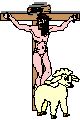 |
|
| Sin | Lamb Promised | Law
(Teacher) | Holy Spirit
( Teacher ) | Promised Lamb Given | Righteous |
| Temporary Shadow | Permanent |
| The temporary system that was our teacher |
Christ is the seed to whom the promise was made. The Holy Spirit is the teacher |
Most people who read this always think about the Ten Commandments. The law engraved on stone will be engraved on our hearts.
It is not annulled. It is strengthened by the work of the Holy Spirit.
But if you look more carefully, it was only the ceremonial laws that were the teachers, that taught us about Christ.
None of the Ten Commandments teach us about Christ, the plan of salvation and what he does for us.
But the ceremonial laws, the feasts and the sanctuary all serve this purpose.
Every piece of furniture, every offering, every feast day, the clothing of the priest, everything ... it all teaches us about Christ.
Only those things within those laws that were accomplished by the death and ministry of Christ were nailed to the cross.
Christ did not come to give us the freedom to be lawless and immoral.
He came to give us the ability to be law abiding people because we love God, we love the law and we want to please God.
Summary: The Feasts After Christ
Have these laws been abolished?
Absolutely not! They still prophesy about Christ.
The only custom that is abolished is the sacrifice of an animal. However, the custom and purpose for the Lamb has not been abolished because Christ is the Lamb that is still bleeding
and His blood is still fresh. So we still have a slaughtered Lamb to offer to God when we sin.
All the events that the feasts symbolize have not been fulfilled. Therefore, it makes sense that they should still be kept.
Jesus said that no law will be abolished until everything is fulfilled.
Do not think that I came to abolish the Law or the Prophets; I did not come to abolish but to fulfill.
(Matthew 5: 17)
"Fulfill" must mean the opposite of abolish.
Let us look at what has been fulfilled and how we should be keeping these feasts today and then we will summarize the teachings of Paul which seems to suggest that the ceremonial laws have been abolished.
| Feast | Date | Leviticus | Numbers | Deut. | After Christ |
|---|
| Eternal Feasts | - | Daily (Continual) | Daily | - | 28: 1-8 | - | I die daily |
|---|
| - | Sabbath (Day 7) | Saturday | 23: 3 | 28: 9-10 | - | Rest from sin |
|---|
| - | New Moon | Month Day 1 | - | 28:11-15;10:10 | - | A new church |
|---|
Merged
Feasts
Sacrifice |
| Atonement | Nisan 14 | 23: 26-32 | 29: 7-11 | - | Gethsemane |
|---|
| Lord's Goat Chosen | Nisan 10 | Leviticus 16; Exodus 12: 3 | Lamb of God |
 | Feast of Tabernacles | Nisan 15-21 | 23:33-44 | 29:12-34 | 16:13-16 | Priest Ordained
Seven Days |
| Spring Feasts | | | Passover | Nissan 14 | 23: 4 | 28: 16 | 16: 1-2 | Death passed over |
|---|
| 1 | Feast of Unleavened Bread | Nissan 15-21 | 23: 5-9 | 28: 17-25 | 16: 3-8 | Separating from sin |
|---|
 | Wavesheaf (First Fruits) | Next Sunday | 23: 10-14 | - | - | Resurrection |
| Wheat First Fruits | - | 23: 10,15 | - | 26 | 3000 Jews accept |
| 2 | Feast of Weeks | +50 days | 23: 15-22 | 28: 26-31 | 16:9-12 | Holy Spirit |
|---|
| Autumn Feasts |  | Feast of Trumpets | Tishrei 1 | 23: 23-25 | 29:1-6;10:10 | - | Judgment |
|---|
| Land Sabbath | Year 7, Tishri 1 | 25: 1-7 | - | 15 | Free from debt |
| Jubilee | Year 50, Tishri 10 | 25: 8-55 | - | - | Inherit the earth |
| Day of Atonement | Tishrei 10 | 23:26-32 | 29:7-11 | - | Sealed |
|---|
| Scapegoat | Tishrei 10 | 16 | - | - | Satan |
| 3 | Feast of Tabernacles | Tishrei 15-21 | 23:33-44 | 29: 12-34 | 16:13-16 | Heaven |
| | Shemini Atzeret | Tishrei 21 | 23: 36,39 | 29: 35-40 | - | Final Judgment |
| | Simchat Torah (8th Day) | Tishrei 22 | 23: 36,39 | 29: 35-40 | - | New Earth |
Since Jesus was sacrificed once for all (Hebrews 7: 27), then all sacrifices for all these feasts and ceremonies must have been completed on Nisan 14.
- Daily. This was a corporate offering that was made continually, one lamb in the morning and the other in the evening. So there was always a sacrifice being offered to God.
I protest by your rejoicing which I have in Christ Jesus our Lord, I die daily.
(1 Corinthians 15: 31)
» Animal Sacrifice. Christ is the sacrifice that died one time for all. But we should die daily to our sins and we should pray and confess our sins daily.
Then we can become the perfect sacrifices that God will use to build His perfect kingdom.
I beseech you therefore, brethren, by the mercies of God, that ye present your bodies a living sacrifice, holy, acceptable unto God, which is your reasonable service.
(Romans 12: 1)
The sacrifice that God has always wanted is real repentance.
For you do not want sacrifices or I would give them; you do not take pleasure in burnt offerings.
My sacrifice to God is a broken spirit; God, you will not spurn a broken, chastened heart.
(Psalm 51: 16-17)
» Circumcision. This ritual prophesied only about the death of Christ.
It was the sign that you had joined the covenant and are willing to die for sin.
Circumcise Your Heart.
In whom also you are circumcised with the circumcision made without hands, in putting off the body of the sins of the flesh by the circumcision of Christ:
(Colossians 2: 11) Deuteronomy 10: 16
The circumcision of Christ is the crucifixion. Through His death we have a remedy for sin.
Paul taught the Gentiles that they did not have to do physical circumcision. They only needed to circumcise their hearts.
Both circumcision and killing a lamb point only to the death of Christ. Therefore, doing circumcision for purposes of the covenant is now just as misguided as killing a lamb for atonement.
However, we need to understand what was done and what is still occurring.
We need to pray daily by faith that the blood of the sacrificed Lamb of God is still available for atonement.
And we need to circumcise our hearts and cut ourselves off from the love of sin by submitting to God as Moses said.
Surrender Your Heart.
So circumcise your hearts and stiffen your neck no longer.
(Deuteronomy 10: 16)
Circumcised by The Holy Spirit.
When the Ten Commandments were written, the words were not simply carved into the stone according to the Jewish tradition, the letters were cut all the way through from the front to the back.
Therefore, when the Holy Spirit writes the law into our hearts, He will cut all the way through, like a circumcision without hands (Jeremiah 31: 33).
The Last Circumcision (Without Hands).
Amazingly, we will all be circumcised at the Second Coming.
The men who were born during the exodus were not circumcised until they crossed over the Jordan river into the Promised Land with Joshua.
Their children whom He had raised up in their place, Joshua circumcised, for they were uncircumcised, because they had not circumcised them along the way.
(Joshua 5: 7)
At the crucifixion Christ led out as He began the exodus. 2000 years along the way we who were born during the exodus will be circumcised at the Second Coming.
Then, our mortal bodies will be cut off (circumcised) and we will put on immortal bodies as we cross over into heaven.
» The Five Important Signs Of Judaism
There are other important signs of Judaism in addition to circumcision, let us see how these affect us.
» SHEMA. The statement of faith that is said daily by the Jews includes most of these signs.
- Love God and His Law (Deuteronomy 6: 4-9). Constantly remember the law of God and keep His commandments. The Holy Spirit helps us by writing the law of God in our hearts to fulfill the covenant.
Jesus points to this statement of the SHMA when He said.
If you love Me, keep my commandments.
(John 14: 15)
For this is the love of God, that we keep His commandments; and His commandments are not burdensome.
(1 John 5: 3)
Put on the Tfellin (Phylactery) and Mezuzah. You and your house must be obedient to the laws of God.
» Tfellin. Boxes containing the law which were strapped on the hand and forehead.
The law must be written in our hearts and minds (forehead) so that we can do them (hands). We must be perfect like God.
» Mezuzah. The law nailed to the doorpost of the house. This is a sign that your house belongs to God.
Blessed is the man that endures temptation: for when he is tried, he shall receive the crown of life, which the Lord has promised to them that love him.
(James 1: 12)
- Avoid the Wrath (Deuteronomy 11: 13-31). If you love God and keep His commandments and put on the tfellin and Mezuzah, then you will avoid the wrath of God.
This exact warning is repeated in the message of the three angels sent to the final generation (Revelation 14).
Therefore, Revelation says that the church after Christ will be obeying the SHEMA.
- Wear the Tzitzit (Numbers 15: 37-41).
The four tassels with a blue cord in the four corners of the outer garment. These are the four nails in the outer corners of the body of Jesus, His hands and feet.
Jesus was held to the cross by the law. He submitted to death and obeyed God and stayed on the cross instead of His own desire to end His suffering.
Our equivalent is to take up our cross and follow Jesus.
For to you it has been granted for Christ's sake, not only to believe in Him, but also to suffer for His sake.
(Philippians 1: 29)
» Take Up Your Cross. So, although you must avoid the wrath of God, you must wear the tzitzit when God requests it and subject yourself to a type of the wrath of God.
For this reason Jesus said:
... My Father if it is possible, let this cup pass from Me, yet not as I will, but as You will.
(Matthew 26: 39)
When Jesus asked to "let this cup pass from Me", it was not simply a moment of weakness or panic, even in this statement He was obeying another law of the SHEMA to avoid the wrath.
Like circumcision, all the signs of the SHEMA must now be internalized and become part of us as the law is written in our hearts.
So we do not abandon these symbols and their meaning, we keep them more.
Wearing these symbols are meaningless if we are not doing them.
We might not wear the tfellin, but we should be known for constantly talking about the love of God and the laws of God.
We might be uncircumcised but we should be known for cutting off the old, sinful lifestyle and turning to God.
We might not wear a tzitzit and tallit but we should be known for our self-sacrifice for the kingdom of God.
- Sabbath. There is still a Sabbath rest to commemorate our final rest from sin. It has not been totally fulfilled.
This law has not been abolished because we are still sinning and sin still pollutes the earth.
For if Jesus had given them rest, then would he not afterward have spoken of another day.
There remains therefore a rest to the people of God.
For he that is entered into his rest, he also has ceased from his own works, as God did from his.
Let us labour therefore to enter into that rest, lest any man fall after the same example of unbelief.
(Hebrews 4: 8-11)
Traditions Of Men
There were two sets of laws written in the old testament. One was the Ten Commandments and the other was called "the law of Moses".
It contained the detailed laws and ordinances. These are what the Jews counted and referred to as the 613 Mitzvot.
Somehow, these laws of Moses became synonymous with the hated "traditions of men" that the "legalistic Jews" made up to keep the law.
This is false. God approved of all of these laws. Therefore they were good. God cannot be the author of good laws which become bad.
The Jews made up other laws so that they could keep these two sets of laws. These are the traditions of men.
Ordinances Nailed To The Cross?
Colossians 2 and 1 Corinthians 11 seem to suggest that all these feasts have been abolished.
We only accept that the following can be replaced with better practices or a better understanding.
Contrary.
The idea that these are "contrary" or "against us" only makes sense with the curses and the animal sacrifices.
- Curses And Death. It is the only law that will not exist any longer. It describes our judgment and punishment and wrath against us until we are dead.
Death is the last enemy to be removed with the curse.
So the laws of the curses in Deuteronomy 28 must contain the "ordinances against us", because all the ordinances listed in the statutes were ordained by God and based on the cyclical pattern of events started at the creation.
- Day And Night (Earth). Darkness existed at creation, so God promised light and this light will continue increasing until the time
when it will be no night (Revelation 22: 5).
» Weekly Sabbath (7 Rotations Of the Earth).
- Month (Moon). The moon affects the ocean tides and sets the fertility clocks.
- Year (Sun).
» Land Sabbath (7 Rotations Of the Sun).
» Annual Harvests (Barley, Wheat, Fruit). They occur at Passover, Pentecost and Tabernacles.
» Rain. Two major seasons of rain (spring and fall) so that there will not be drought.
» God's Grain Harvest (Annual Tithe). Food to eliminate famine.
» God's Fruit Harvest (3.5 Years).
The curses organized on the same cycles.
What does this mean?
No Darkness.
The sun shall not smite thee by day, nor the moon by night.
(Psalm 121: 6)
God has taken us out of the darkness, drought and the famine by giving us light (law), food (word of God), water (cleansing us with righteousness).
This attempt to make us ignore the laws of God is darkness and rebellion.
- Blotting Out Our Sin Record. Satan is our constant accuser who condemned us to death.
And I heard a loud voice saying in heaven, Now is come salvation, and strength, and the kingdom of our God, and the power of his Christ: for the accuser of our brethren is cast down, which accused them before our God day and night.
(Revelation 12: 10)
By taking our sins as His own, God has removed the record of sin and ignored the accusations of Satan.
At the final judgment, all these sins will be transferred to Satan. He was the cause and he will be executed under the same laws with which Satan hoped to permanently condemn us.
- Sacrifice And Grain Offering. According to Daniel this is what the Messiah will abolish.
And he shall confirm the covenant with many for one week:
and in the midst of the week he shall cause the sacrifice and the oblation [grain offering] to cease,
and for the overspreading of abominations he shall make it desolate, even until the consummation, and that determined shall be poured upon the desolate.
(Daniel 9: 27)
» Animal Sacrifices and Circumcision. They represent the death of Christ for our sins. Pray daily for forgiveness by faith in the blood of Christ and die to sin daily by cutting off any love for it in our minds and hearts.
This is why our hearts must be circumcised.
So until this requirement is fulfilled in us, circumcision needs to be understood. It is the Holy Spirit who is circumcising our hearts.
Since we are still sinning and dying we must daily take the perfect Lamb as our atomement.
- Pilgrimages.
The local pilgrimages also seem burdensome because of the logistics. Global access, cost and accommodation seem impractical with a sucessful world-wide movement.
We no longer need to travel to Jerusalem or any place for the three annual feasts. Currently, our Jerusalem and High priest is in heaven.
Our fathers worshiped in this mountain, and you people say that in Jerusalem is the place where men ought to worship."
Jesus said to her, "Woman, believe Me, an hour is coming when neither in this mountain nor in Jerusalem will you worship the Father."
You worship what you do not know; we worship what we know, for salvation is from the Jews.
But an hour is coming, and now is, when the true worshipers will worship the Father in spirit and truth; for such people the Father seeks to be His worshipers.
God is spirit, and those who worship Him must worship in spirit and truth."
(John 4: 20-24) NASB
So Jesus told the woman at the well, we no longer need to worhsip God on any mountain at Jerusalem or Shiloh.
However, in the new earth, when God places His throne on earth, there may be some sort of global ability to have visible access to God from anywhere in the universe on the Sabbath.
Not merely like television or Satellite but also co-location.
We will worship in the Spirit.
More Fulfillment.
- Wavesheaf. The barley and wheat harvests have been gathered, therefore the ceremonies, Sabbaths, food offerings and drink offerings associated with these two feasts must be replaced by an understanding of what they mean.
We must trust in a future resurrection like the barley harvest otherwise our faith is in vain. There is a fuit harvest at the Second Coming.
- New Moon. One new moon was fulfilled at the time of the disciples. For our generation, the seventh new moon that represents the last church should be kept and that is Rosh Hashanah.
Since the tree of life bears fruit every month, then the beginning of the new moon must represent the time we gather for this feast for renewed life.
Changed By The Cross
Everybody assumed that Paul was talking about abolishing the entire feast system.
But he only implies that they were being judged negatively in regards to whatever they were doing, or not doing.
Taking my previous arguments about the feasts, suppose He was talking about being judged for the changes they made in the ordinances to reflect the events that were fulfilled by Christ.
So what did Paul teach?
| Christ Nullified The Curses and Wrath |
|---|
| Penalty | Curse | Wrath | Christ |
|---|
 | Hard Labor | Carries the cross | Breathing on the cross | Sabbath rest |
|---|
| Thorns and Thistles | Crown of thorns | Nails | Feast (Food) |
|---|
| No Fruit (Famine) | Abandoned by Israel | Abandoned by God | Feast (Drink) |
|---|
| | Return to Dust | Fell | Death | Life |
|---|
 | Submission | Arrest, trial | Crucifixion | Triumph |
|---|
| Pain in Childbirth | Peter's denial | Birth of the church | Joy |
|---|
| Naked | Gambled for clothes | Naked on the cross | Robes of righteous |
|---|
| Lost Paradise | No Israel | Sent to sheol | Heaven |
|---|
| Sword (War) | Peter's sword | Pierced side | Peace |
|---|
| Separation | No friends | Cut off | Assembly |
|---|
| Darkness | Night | Dark day | New moon |
|---|
Punishment of Adam. (Genesis 3: 17-19)
Punishment of Eve. (Genesis 3: 15-16)
|
|
- Ordinances Against Us. The feast were not against us. In fact, they teach what God has done for us. The only laws that were against them were the curses that they agreed to in the covenant which were inherited from the curses on Adam and Eve.
When Christ died He suffered these curses as the wrath of God was poured out on Him for us.
So He accomplished two punishments for us on the cross. He died for our sins and He suffered the wrath of God in the curses poured out on humanity.
Debt.
Having canceled out the certificate of debt consisting of decrees against us, which was hostile to us, and He has taken it out of the way having nailed it to the cross.
Debt Paid. When He had disarmed the rulers and authorities, He made a public display of them, having triumphed over them through Him.
(Colossians 2: 14-15)
Paul suggests that this burdensome debt written in the curses was instigated by malevolent "rulers and powers". They were demanded by Satan.
The context also suggests that these offerings nullified the curse.
So no one can judge us, not even these powers because Christ paid the penalty of the curses. What remains are the symbols that He has triumphed over the curses.
These symbols are the Sabbath, the feasts and the new moons! They are symbols of the body of Christ.
- Nailed To The Cross. In this lesson we address these issues.
Blotting out the handwriting of ordinances that was against us, which was contrary to us, and took it out of the way, nailing it to his cross;
Let no man therefore judge you in meat, or in drink, or in respect of an holyday, or of the new moon, or of the Sabbath days:
Which are a shadow of things to come; but the body [is] of Christ.
(Colossians 2: 14, 16-17)
» The Body of Christ.
They are the shadow of future things which point to Christ as the fulfillment.
Here are the changes which are reflected in the work of Christ. They are the shadows which have passed.
Daniel 9: 27 says that the death of Christ only canceled the sacrifice and grain offering [oblation].
- Meat (Food) and Drink. He would have abolished the wavesheaf food offerings or changed them.
Christ is now our food and drink. Although this must be understood in the spiritual meaning we must still symbolize this in the communion service (Passover meal) which we no longer do at Passover only but as "often as possible".
"This is the bread which comes down out of heaven, so that one may eat of it and not die.
"I am the living bread that came down out of heaven; if anyone eats of this bread, he will live forever; and the bread also which I will give for the life of the world is My flesh."
So Jesus said to them, "Truly, truly, I say to you, unless you eat the flesh of the Son of Man and drink His blood, you have no life in yourselves.
"He who eats My flesh and drinks My blood has eternal life, and I will raise him up on the last day.
Therefore many of His disciples, when they heard this said, "This is a difficult statement; who can listen to it?"
As a result of this many of His disciples withdrew and were not walking with Him anymore.
(John 6: 50-51,53-54, 60,66)
 Christ is the body we eat in the feasts. So every time we eat the bread and wine of communion we remember that His death gave us life. We will also have this meal in the new earth. It is not abolished.
- Holy Days (Feasts). Since the crucifixion, these times are now our feast days. It is now the time to eat from the feast of God which He prepared at Passover and celebrate the fact that death has passed over us.
Christ is the body of the sacrifice prepared for all the feast days.
- Sabbaths. The wavesheaf offerings were Sabbath days. These are not the weekly Sabbaths.
However, Hebrews says that there remains a Sabbath rest and He did not authorize another day.
Christ is the body at rest on Sabbath and in Whom we rest during the Sabbath. So every Sabbath we celebrate the fact that He gave us rest from sin and that He is recreating us in His image.
- New Moons. Isaiah 66: 23 says that we will be keeping the new moons and Sabbaths in the new earth when we go to worship God on a weekly and monthly cycle.
So they must have realized that the new moons would be fulfilled in time just as the Passover was. So the issue would be whether or not to keep them when that church has passed away in history. The first new moon had passed for them.
Christ is the body in the new moon. He is the first sliver of light after the darkness of sin engulfed the world.
This body of Christ becomes the full moon which is the perfect church. Celebrate the light!
None of these symbols can be characterized as "against us" or oppressive. So do not let anyone judge you for observing them, because they point to the work of Christ.
The truth is that God always leaves a symbol of each great truth that is being taught so that we do not forget.
While the symbols do not save, they must be obeyed until their time is fulfilled because a future generation that fulfills them needs to know how to do so because they will totally understand why.
Therefore, we should take communion, we should be baptized and we should observe these symbols and we should observe the symbol that is also a moral law, the Sabbath.
- Shadows To Come. Notice that these ordinances are about future events about Christ. They have not been fulfilled!
And if they have not been fulfilled, they have not been abolished according to Christ's own words.
Therefore, the only issue is how to change them to reflect what Christ accomplished at the cross.
Although new Bible translations are trying to change the tense form "are a shodow of things to come" to "were a shadow", the fact that all these feasts will be celebrated is proof that there is a greater fulfillment in the future
- Sabbath. There remains a Sabbath day for the people of God and there is o change.
- Passover. Jesus said He will be celebrating it with us in the kingdom and we should do it to remember Him.
- Pentecost. The Holy Spirit will be pored out a second time during the Latter Rain.
- Rosh Hashannah. The final judgment will begin for all people.
- Yom Kippur. The scapegoat will be captured and confined in the millennium, then judged and executed.
- Tabernacles. God will live with us on the new earth. We will be with Him in heaven at the Second Coming.
- New Moon. On the new moon, 12 times per year we will be eating the fruit from the Tree of Life.
- Changed Ordinances. He gave them ordinances to follow!
Now I praise you, brethren, that you remember me in all things, and keep the ordinances, as I delivered them to you.
(1 Corinthians 11: 2)
The phrase, "as I delivered them to you" suggests that he gave them ordinances and he made a change in them.
The one change that He must have made was to stop sacrificing a lamb.
They substituted this with prayer.
This letter mentions keeping the Passover but it does not exclude other ordinances.
Since the Passover seems to be fulfilled except for Jesus eating with us in the new world, it must have made sense that He had to explain to them that Christ Himself asked them to continue the ordinance for the purpose of remembering Him.
Verily I say unto you, I will drink no more of the fruit of the vine, until that day that I drink it new in the kingdom of God.
(Mark 14: 25)
2000 years later, we need this ordinance to bring Christ in remembrance to the Jews as their Messiah.
After the same manner also he took the cup, when he had supped, saying, this cup is the new testament in my blood: this do ye, as oft as ye drink it, in remembrance of me.
(1 Corinthians 11: 25)
- The New Priesthood. It has not changed but was restored. The Levitical priesthood has been abolished in favor of the Melchizedek priesthood (Hebrews 7: 12-13).
- Levi. This priesthood is a hierarchical masculine club which produced only one righteous Man from the tribe of Judah.
All the laws and types pointed to this single human being.
In addition, the priesthood was not open to the common people and they were excluded from using any of its gifts.
Within the priesthood, only some from the line of Aaron could enter the temple while others served outside. Within that elite group only the high priest could enter the Most Holy Place and then only one day each year.
- Melchizedek (King Of Salem).
He was probably the son of Shem or Shem himself by this name. As a righteous priest of God, he blessed Abraham and his seed as the inheritors of the priesthood.
For this Melchisedec, king of Salem, priest of the most high God, who met Abraham returning from the slaughter of the kings, and blessed him;
To whom also Abraham gave a tenth part of all; first being by interpretation King of righteousness, and after that also King of Salem, which is, King of peace;
Without father, without mother, without descent, having neither beginning of days, nor end of life; but made like unto the Son of God; abideth a priest continually.
Now consider how great this man was, unto whom even the patriarch Abraham gave the tenth of the spoils.
(Hebrews 7: 1-4)
Noah died when Abraham was 58 years old.
Abraham was the 9th generation after Shem who lived to see the 11th generation, Isaac and Jacob and probably the first sons of Jacob who had a wife around the age of 40.
Noah and his sons lived hundreds of years after (500 years) but those after the flood lived less than 240 and were fertile by their 30th age.
Shem lived for 600 years and died 33 years after Abraham died at age 175. Isaac was 108 years, Jacob was 48 years old when Shem died.
So Shem was alive after Abraham died.
If he is Shem who was considered "of no origin" it was because he lived for about 12 generations, and they forgot him.
» Shepherd-Kings.
Legends claim that Cush and Nimrod ruled the region of Egypt and became godmakers by deifying the fallen wicked in the flood as gods.
Shem is credited with bringing about the death of Nimrod and some of his companions and freeing the word from their tyranny.
He overthrew the land without violence while Shem was away and remained as the bearded shepherd-kings in Egypt and then moved to Salem.
Even with these laws it can still be argued that the law has not been changed. The status of the people has changed, placing them in another group where these rights are recognized under the old law.
However, you might argue successfully that even under the old law only the High Priest entered the Most Holy Place and under the new law we can only be common priests who could never enter this room even though Christ has torn the veil so that we can see inside.
Well, there is only one condition under which we can enter the Most Holy Place without a change of law.
If the High Priest is pregnant or we are inside the High Priest then we can enter by default.
Impossible you say?
At the original creation it was Adam who gave birth to the woman.
In the new creation it is the new Adam who will give birth to the woman (the church).
If we abide in Christ we are in the Most Holy Place by faith.
Abide in Me and I in you ...
(John 15: 4)
- The Freedom Of Priests. We are now priests with privileges. So everything that the priests could touch, we can touch. Everything that belongs to them belongs to us.
And because the veil to the Most Holy was torn, the High Priest is inviting us there. So we can go boldly to the throne of grace.
So we are no longer under these restrictions. We are no longer among the common people who could not touch the sacred things of God.
If you have died with Christ to the elementary principles of this world, why, as if you are living in the world, do you submit yourself to decrees such as,
Do not handle, do not taste, do not touch!
(Colossians 2: 20-21)
- All People. A righteous people will reign with Christ as kings and priests (Revelation 20: 6).
The priesthood is open to both genders from all the common people who now have continual access to the Most Holy Place.
It will produce a nation of righteous priests.
Equality.
For you are all sons of God through faith in Christ Jesus.
There is neither Jew nor Greek, there is neither slaves nor free man, there is neither male nor female, for you are all one in Christ Jesus.
(Galatians 3: 26, 28)
The curse of submission is removed. Both genders submit to each other and to Christ.
|
Study to show yourself approved to God as a workman who does not need to be ashamed, accurately handling the word of truth.
2 Timothy 2: 15
|
Time: 100 minutes
Print: 23 pages |
Copyright
Updated : August 25, 2004. February 2008.
Credits:
Author: Laverna Patterson. Editor: Patterson (January 2008)
|

 Pray First